Since the United States and Israel launched airstrikes against Iran on February 28, 2026, the war has intensified and spread to neighboring countries. Although the U.S. and Israeli forces possess overwhelming military superiority and have destroyed Iran’s navy and air force, Iranian missile units have continued to launch missile attacks against Israel and U.S. military bases in the Middle East.
By threatening missile strikes on commercial vessels, the Iranian Revolutionary Guard Corps (IRGC) has effectively closed the Strait of Hormuz — a critical chokepoint for the transport of oil and liquefied natural gas from the Persian Gulf to the Gulf of Oman and the Arabian Sea. The IRGC has further demanded that every vessel passing through the strait pay a substantial fee, an act of extortion that no nation can accept.
The IRGC has also threatened to attack oil infrastructure and power plants in Israel and neighboring Gulf nations if their own energy facilities are targeted by the United States and Israel.
Such retaliation would only accelerate Iran’s isolation from the Gulf countries and potential total destruction by the U.S. and Israeli forces, as its air defenses have already been eliminated by U.S. and Israeli
airstrikes.
Nevertheless, missile attacks on energy infrastructure in neighboring Gulf states risk triggering a severe regional oil crisis, with potential global financial repercussions, as well as a catastrophic environmental disaster. As additional nations are drawn into the conflict and Iran receives more support from Russia and China, this regional war could escalate into a catastrophe of biblical scale — the “Armageddon” prophesied in the Book of Revelation (16:16).
To end this war with Iran without triggering the prophesied catastrophe of “Armageddon,” it is essential to carefully examine the background, underlying causes, and key factors that will shape the war’s ultimate outcome and to find the solution that minimizes the risk of the catastrophic disaster of “Armageddon”.
I. The Main Causes of the United States-Israel War Against Iran
1. The Extremist Islamic Regime Has Been at War with the United States and Israel for 47 Years Since its Islamic Revolution in 1979
Some have argued that the United States and Israel initiated the current war on February 28, 2026. In reality, the extremist Islamic regime of Iran began its conflict with the United States and Israel 47 years ago, when it seized power through the Islamic Revolution of 1979. At official state events, Iranian leaders have repeatedly declared their ultimate goals: “Death to Israel” and “Death to America.”
On November 4, 1979, Iranian revolutionaries stormed the U.S. Embassy in Tehran and took 66 Americans — including diplomats and other civilian personnel — hostage. Fifty-two of them were held for 444 days until their release on January 20, 1981.
In April 1983, the Islamic Jihad, an Iran-backed terrorist group, carried out a suicide car bombing at the U.S. Embassy in Beirut, killing 17 Americans. In October 1983, Iran-backed Hezbollah terrorists killed 241 U.S. military personnel — including 220 U.S. Marines and 21 other service personnel — in a truck bombing at a Marine compound in Beirut.
In June 1996, Iran-backed Hezbollah Al-Hijaz terrorists killed 19 U.S. Airmen and wounded nearly 500 others in a truck bombing at a U.S. Air Force housing complex in Saudi Arabia. In August 1998, Al-Qaeda suicide bombers, facilitated by Iran-backed Hezbollah, simultaneously bombed U.S. embassies in Kenya and Tanzania, killing 224 people — including a dozen American citizens.
Between 2003 and 2011: Iran-backed militias killed at least 603 U.S. troops in Iraq — “roughly one in every six American combat fatalities in Iraq.” Between October 2003 and November 2024, Iran and its proxies conducted more than 180 attacks against U.S. forces in the Middle East, wounding more than 180 U.S. service members and killing three service members.
Over the past 47 years, the extremist Islamic regime of Iran has been the leading state sponsor of terrorist attacks against the United
States and Israel. Previous U.S. administrations were either too cowardly, too incompetent,
or too preoccupied with other conflicts to confront Iran directly. This policy of non-response only emboldened the regime to escalate its
attacks
against the United States and Israel.
Today, as Iran stands on the threshold of developing nuclear weapons, the consequences could be catastrophic if it acquires them and transfers them to terrorist groups such as Hamas and
Hezbollah. These jihadist terrorists would not hesitate to detonate a nuclear device
or launch a nuclear attack on Israel and the United States if given the opportunity.
Their ultimate goal is to annihilate all 10 million Israelis and wipe Israel from the surface of the Earth. In retaliation, Israel could also kill millions of its enemies. That scenario would represent the Catastrophe of “Armageddon” prophesied in the Bible’s Book of Revelation.
That scenario would represent the true “Armageddon” prophesied in the Bible’s Book of Revelation.
The United States and Israel therefore has no choice but to prevent Iran from acquiring nuclear weapons. Failure to do so could result in the loss of millions of lives in a catastrophic nuclear conflict that
originates in Iran, engulfs the Middle East, and potentially spreads worldwide.
2. The Massacred of 45,000 Iranians by the Murderous Iranian Regime
Since the Islamic Revolution in 1979, Iran's extremist Islamic regime has oppressed its people for 47 years with ruthless, medieval-style laws rooted in rigid Sharia interpretations. These policies have impoverished most Iranian people while enriching the ruling clerical elite.
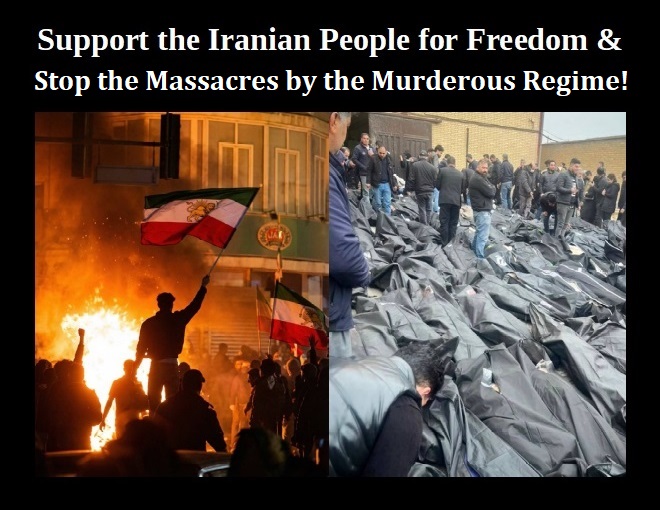
At the end of 2025, nationwide protests erupted across Iran, driven by deep-seated grievances including economic collapse, corruption, and long-standing demands for freedoms. These demonstrations quickly grew into one of the largest protests in decades, with Iranians abroad organizing supportive rallies that drew over one million supporters worldwide in solidarity with the brave Iranians inside Iran.
Tragically, the extremist Islamic regime responded with extreme brutality, massacring over 35,000
(up to 45,000 as President Trump claimed) mostly unarmed protesters during the crackdown in early January 2026. This unforgivable atrocity—among the deadliest episodes of state repression in modern Iranian history—has been condemned globally as mass murder against the nation's own citizens.
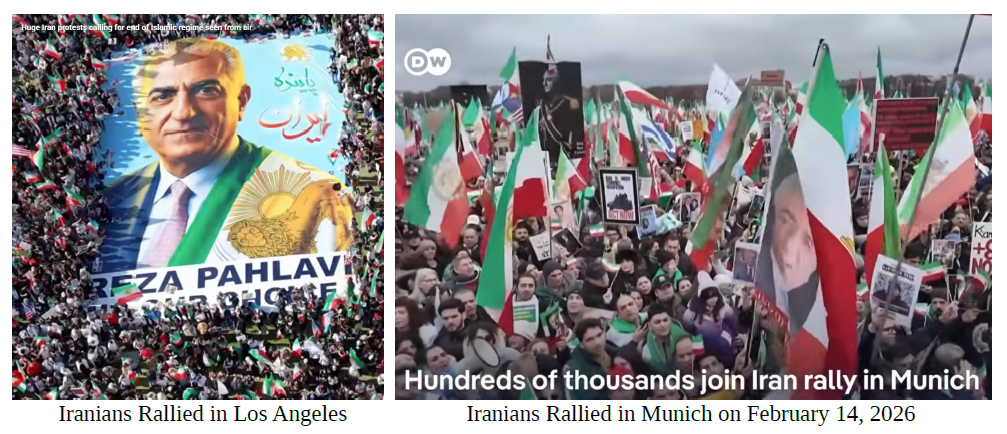
In response to this bloodshed, exiled Iran Crown Prince Reza Pahlavi called for global demonstrations in solidarity with those inside Iran. On February 14–15, 2026, over one million people held massive rallies across Europe, North America, and Australia, voiced their support for the Iranian people's struggle against the regime and called for international intervention to end this murderous regime's ongoing atrocities.
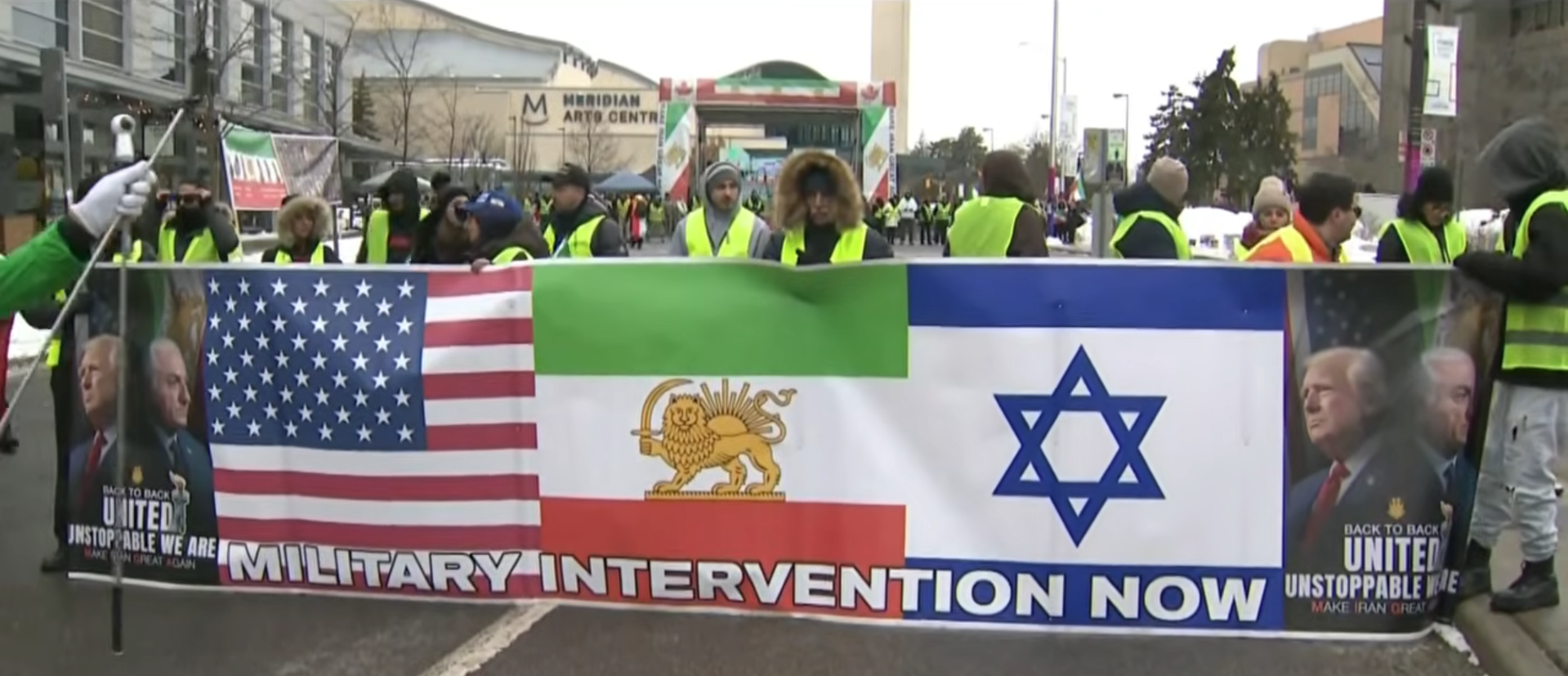
Iranians and Supporters Rallied at Toronto on February 14, 2026
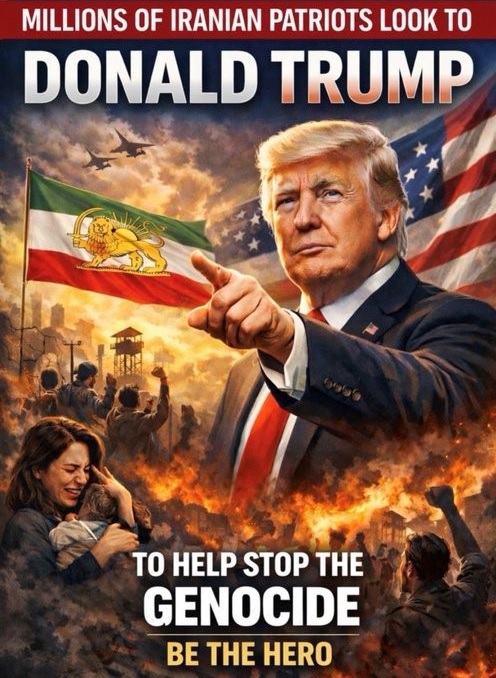
During the widespread protests in January 2026, over a million Iranian people appealed to U.S. President Donald Trump for military intervention to stop the massacres by the murderous Iranian regime. “Vox Populi, Vox Dei” (“The Voice of the People is the Voice of God”). When over a million Iranian people called for rescue, President Trump could not reject such a call for help, and he promised to the brave Iranian people, “help is on its way.” He subsequently ordered the U.S. aircraft carrier USS Abraham Lincoln—along with its associated carrier strike group—to deploy toward the Persian Gulf.
On February 28, 2026, President Trump fulfilled this promise to Iranians through coordinated U.S.-Israeli airstrikes, designated as Operation Epic Fury, targeting key elements of the Iranian regime. Within the first week, coordinated airstrikes destroyed numerous Iranian Revolutionary Guard Corps (IRGC) bases, sank most of Iran's navy vessels, and neutralized a significant portion of its military aircraft and ballistic missile capabilities.
The Operation Epic Fury was the answer to the calls from oppressed Iranian people after the murderous Iranian regime massacred
up to 45,000 of unarmed Iranian people in January 2026. As the result, Iran's Supreme Leader Ayatollah Ali Khamenei and over two dozen top military, security, and government officials—including the defense minister, IRGC commander, and others—were killed in the initial US-Israeli strikes. Those Tehran Butchers who were responsible for the massacre of
45,000 Iranian protesters were mostly eliminated. That’s the judgment of God on those murderers of
unarmed Iranian protesters.
II. The Judgment of God on the Extremist Islamic Regime of Iran
Over the past 47 years since the 1979 Islamic Revolution, Iran's extremist regime has imposed rigid, medieval-style laws to oppress its people and plunged the nation into a modern Dark Age of authoritarian theocracy with suppression of dissent and severe restrictions on personal freedoms. Its ruling class also falls into the sin of corruption by stealing money from the Iranian people and smuggling it to the offshore accounts, which allows their children to live luxury lifestyles in the West while most Iranians struggle amid a severe financial crisis marked by ultra-high inflation.
The current situation in Iran is very similar to the Dark Age in the Later Medieval period in Europe (1300s–1500s), where the Roman Catholic Church had near-absolute control over the secular world, branding dissent as heresy and enforcing it through persecution by the Inquisition. Similarly, Iran's clerical establishment exerts tight control over all aspects of Iranian people's life, punishing any deviation with imprisonment, torture, or execution through Islamic courts.
Since Islam began in the seventh century, approximately six hundred years after Christianity began in the first century, what happened in many Islamic countries today resembles what occurred during the Dark Ages in the Christian world six hundred years earlier. That’s the learning curve most major religions in the world have experienced in the past four thousand years.
1. The Judgment of God on the Massacre of
45,000 Iranians during the Nationwide Protests in Iran
Currently, the extremist Islamic regime in Iran is repeating the same mistakes the
Roman Catholic Church made during the Dark Age six hundred years ago. This pattern of repression fueled massive nationwide protests erupting in late December 2025 and intensifying into January 2026, with millions demanding an end to the regime amid economic collapse and long-standing grievances.
Tragically, the Iranian government's response was ruthless: it imposed nationwide internet blackouts to conceal its actions and carried out mass killings of unarmed protesters, with death toll estimates over
35,000 (up to 45,000, as President Trump claimed). Security forces even entered hospitals to execute wounded demonstrators, detained and tortured the nurses caring for the injured. Some of the nurses were even gang-raped by the Iranian security forces and its associated militias. These are the horrific crimes against humanity for which the regime's leaders must be held accountable.
God has mercy on the long-suffering Iranian people, and the judgment of God came swiftly on those Tehran butchers who ordered the massacre of Iranian people. Since the United States of America and Israel launched the airstrike against Iran on February 28, 2026, most of those Tehran butchers who were responsible for the massacre of
45,000 Iranian people have been eliminated, including the Supreme leader of Iran Ayatollah Ari Khamenei and top commanders of the Islamic Revolutionary Guard Corps (IRGC) and Basij militia forces.
This is a clear warning to all authoritarian regimes: God is merciful toward all people on earth. No government should abuse its power to mistreat, persecute, or massacre its own citizens. If any authoritarian regime ruthlessly massacres its own people, the wrath of God will come upon it swiftly. Regime change in Iran is now imperative to end this era of repression, especially after it massacred over
45,000 Iranian people during the nationwide protests in January 2026.
2. The Judgment of God on the IRGC’s Attacks on the Neighboring
Gulf Countries
After the United States and Israel launched military strikes against Iran on February 28, 2026, the Iranian regime retaliated not only against U.S. and Israeli targets but also against neighboring countries hosting U.S. military bases—including Bahrain, Qatar, Kuwait, the United Arab Emirates, Saudi Arabia, Jordan, and others. These attacks extended to allied sites and, in some cases, civilian infrastructure.
Additionally, Iran has effectively blocked the Strait of Hormuz, halting or severely restricting about 20% of global oil flows. This has triggered an oil crisis, with crude oil prices surging by around 40%, contributing to elevated global inflation and energy costs.
On March 18, 2026, Iran began to strike on the oil refineries in Saudi Arabia and Kuwait and launched missile attacks on Qatar’s Ras Laffan Industrial City, home to the largest liquefied natural gas(LNG) export facility in the world. Most Arab nations now recognize the threat posed by this extremist Islamic regime—the primary sponsor of terrorism in the Middle East and a terrorist entity itself.
The relentless missile attacks by the IRGC only strengthen Gulf nations’ determination that only regime change can eliminate the threat Iran poses to its neighbors and bring lasting peace to the region.
3. The
Judgment of God on the Revival of the Thousands-of-Years-Old Friendship between
Iran (Persia) and Israel
The key to bringing lasting peace to the Middle East is to revive the thousands-of-years-old of friendship between Iran (Persia) and Israel. Actually,
before the 1979 Islamic Revolution, Iran and Israel enjoyed a good friendship under Shah Mohammad Reza Pahlavi. Iran became the first Muslim-majority country in the Middle East to recognize Israel following its establishment in 1948 after World War II. The historical ties between Persia (modern-day Iran) and the Jewish people extend back over 2,500 years.
In 539 BCE, Cyrus the Great of Persia defeated the Babylonian Empire at the Battle of Opis, conquering Babylon and ending the Babylonian captivity of the Jews. He permitted the Jewish exiles to return to Jerusalem and rebuild the Second Temple. Cyrus the Great was the only non-Jewish figure in the Hebrew Bible hailed as “messiah” or “anointed one,” in Isaiah 45:1.
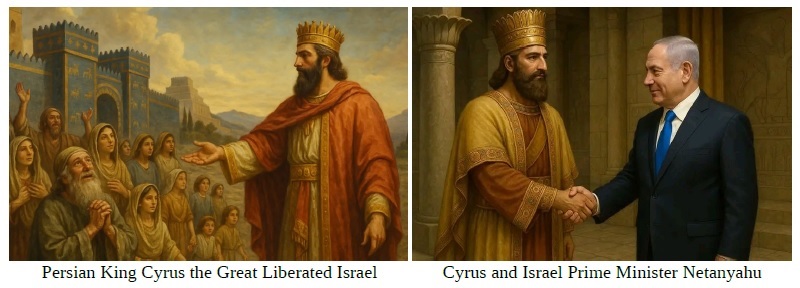
Nowadays, most Jewish people still remain grateful to the Persian King Cyrus the Great for liberating the Jewish people from the Babylonians and allowing them to rebuild the Temple in Jerusalem 2500 years ago. Israeli Prime Minister Benjamin Netanyahu publicly stated to the Iranian people that this time Israel would return Cyrus’ historic favor—liberating the Iranians from the oppressive Islamic regime in the same way Cyrus the Great once liberated the Jews.
It is God’s plan to let these two ancient nations revive their
thousands-of-years-old friendship once again.
4. The Solidification and Expansion of the Abraham Accords among the Descendants of Abraham
In September 2020, the United Arab Emirates and Bahrain signed agreements with Israel to normalize diplomatic relations. In the following months, Sudan and Morocco also joined the accords, although Sudan’s agreement remains unratified as of late 2024. These historic agreements, known as the Abraham Accords, recognize that both Israelis and Arabs are descendants of their common ancestor, Abraham. The accords were mediated by the United States under President Donald Trump during his first term.
Today, the common threat posed by the extremist Iranian regime has created an urgent need to expand the Abraham Accords to additional Arab nations in the Gulf. Strengthening these agreements will not only help secure lasting peace in the Middle East but also facilitate the post-war reconstruction and rebuilding of the region, including the Gaza Strip. It is God’s will to reconcile the children of Abraham and bring enduring peace to the Middle East.
5. The Improvement of the Relationship between Iran and the United States of America
Persia also holds a special place in Christian tradition: the three Magi (or wise men) who followed the Star of Bethlehem to bring gifts of gold, frankincense, and myrrh to the infant Jesus are traditionally believed to have come from Persia, a region renowned for its advanced knowledge of astrology in antiquity. Many Christians in the United States would like to help Persia—now Iran—restore its glorious history and culture.
However, the 1979 Islamic Revolution fundamentally altered Iran's trajectory. The new regime dismantled aspects of traditional Persian culture, adopted a sharply anti-Western and anti-Israel stance, and popularized slogans such as “Death to Israel” and “Death to America.”
Since the 1979 Islamic Revolution, Iran has engaged in a decades-long campaign of attacks against the United States, utilizing both direct actions and proxy forces like Hezbollah and the
Houthis. Major incidents included the 1979 U.S. embassy hostage crisis, the 1983 Beirut barracks bombing, the 1996 Khobar Towers bombing, support for militias that killed over 600 U.S. troops in Iraq, and the capture of U.S. Navy vessels followed by the public humiliation of American sailors in exchange for a $1.7 billion ransom in cash.
Unfortunately, previous U.S. presidents chose not to respond forcefully to these provocations by the extremist Islamic regime. President Trump is the first U.S. president with the courage and determination to confront and defeat this regime.
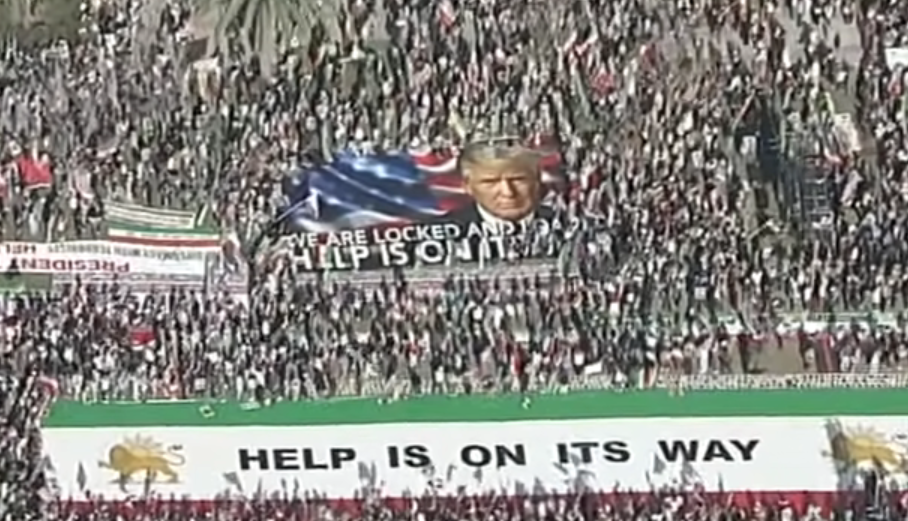
The Supporters of
Iranians rallied in Los Angeles on February 14, 2026
On February 28, 2026, President Trump fulfilled this promise to the Iranian people through coordinated U.S.-Israeli
airstrikes, designated as Operation Epic Fury in U.S. and Operation Roaring Lion
in Israel, targeting key elements of the Iranian regime. Those who were responsible for the massacre of 45,000 Iranian protesters were mostly eliminated.
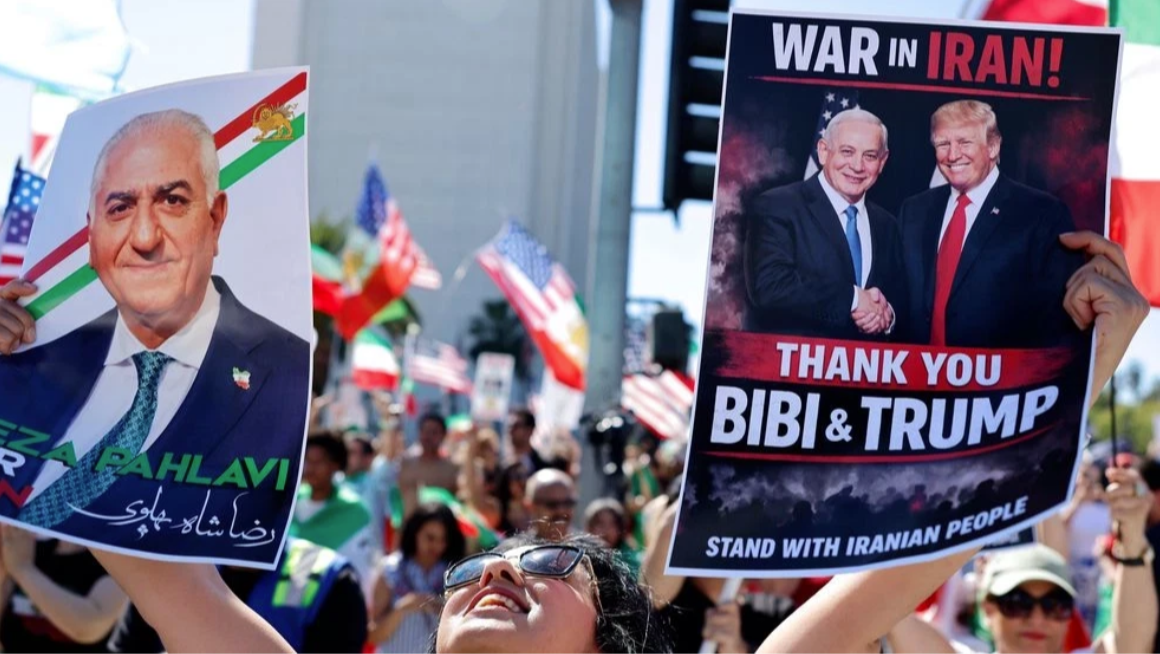
Iranians showed the sign of "Thank you Bibi
(Netanyahu) and Trump"
Therefore, it is God’s judgment, as
well as the people's will, that the extremist Islamic regime in Iran must come to an end, especially after it massacred
45,000 unarmed protesters in January 2026. With most of the leaders responsible for this atrocity now eliminated, the remaining Iranian military personnel and security forces should immediately cease all repression against the Iranian people and halt further aggression toward neighboring countries. Once the New Iranian government can ceasefire and reach a peace agreement with the United States and Israel, Iran will have a strong opportunity to rebuild and significantly improve its struggling economy.
A similar transformation occurred in Iraq around the 2003 war. In 2002, prior to the Iraq War, Iraq’s nominal GDP was approximately $21 billion. Most citizens endured severe poverty and shortages of basic necessities, including medicine, while the ruling elite under Saddam Hussein lived comfortably despite international sanctions. By 2013, ten years after the regime’s overthrow by the United States and its allies, Iraq’s GDP had risen to $234 billion—more than a tenfold increase.
It is God’s plan to send the United States to liberate the oppressed Iranian people from the authoritarian extremist Islamic regime, just as God sent the United States to liberate the oppressed Iraqi people from Saddam Hussein’s authoritarian regime twenty years ago. However, if the IRGC continues fighting the United States or attacking neighboring Gulf states, Iran risks irreversible war damage from this mission of God. Ending the oppressive regime and pursuing peace presents a historic opportunity for the Iranian people to secure a much brighter future for Iran.
6. The End of the Dark Age in Iran
For nearly five decades, the Extremist Islamic Regime has ruled Iran under a medieval-style theocracy, systematically oppressing its people through severe human rights violations—including arbitrary arrests, torture, extrajudicial executions, and systemic gender discrimination, particularly against women. Its policies and governance resemble those of Europe during the Dark Ages approximately six centuries ago.
In addition, the regime has allocated the majority of its resources to the military expansion of the Islamic Revolutionary Guard Corps
(IRGC) and to sponsoring terrorist organizations across the Middle East, while neglecting the welfare of its own citizens. These mismanaged priorities are widely regarded as a primary cause of Iran’s current economic and financial crisis.
God has mercy on the 93 million
oppressed Iranian people who have endured decades of hardship under this
extremist Islamic regime. The time has come to end the Dark Age in Iran under
the brutal rule of this extremist Islamic regime and to grant the Iranian people
the long-deserved freedom of speech and freedom of religion.
The most effective way to end this war in Iran is to establish a fully democratic government free from any religious oversight or interference in secular affairs, thereby ending decades of theocratic control over civilian life.
Once a democratic government is established in Iran and it stops financing terrorist groups in the Middle East, the international sanctions against Iran can be lifted. With its abundant oil resources and stable oil revenues of hundreds of millions of dollars per day, Iran could soon recover from the current financial crisis and rebuild itself into a peaceful and prosperous country in the Middle East.
III. The
Peaceful Solutions to End the War in Iran without Causing the Catastrophe of “Armageddon”
Currently, the United States and Iran are in a ceasefire attempting to negotiate a long-term ceasefire or comprehensive peace agreement to end the conflict. However, if Iran insists on retaining its nuclear program or imposing tolls on every vessel passing through the Strait of Hormuz, there is virtually no prospect of an internationally recognized long-term peace agreement.
With the current extremist Islamic regime remaining in power, its medieval-style theocracy will not change, nor will its deep hostility toward the United States and Israel. It will continue using its oil revenue to fund terrorist groups across the Middle East. Consequently, lasting peace in the region will remain unattainable, and the suffering of the Iranian people will persist indefinitely.
Therefore, the most favorable outcome of this war would be regime change in Iran — replacing the current theocracy with a modern, democratic state. As the Iranian people are deeply proud of their nation, they will not surrender to any foreign power. However, if a reputable Iranian leader emerges who can guide the country toward modern democracy with peace and prosperity, most Iranians would likely support him and rally behind his efforts to revive a nation with a once-glorious history. The best candidate for a pro-democratic Iranian leader is Exiled Crown Prince Reza Pahlavi, who has resided in the Western World for over 47 years and yet with deep root in the Iranian history.
1. Establish a New Iranian Government
for a Free and Democratic Iran
After 47 years of oppression under the
authoritarian theocratic rule of the extremist Islamic regime in Iran, many
Iranians yearn for a free and democratic Iran. They want to return to the
pre-revolutionary era under Shah Mohammad Reza Pahlavi (r. 1941–1979), the
last Shah and father of the exiled Prince Reza Pahlavi. Following the Shah's
death in 1980, his eldest son, Crown Prince Reza Pahlavi, has emerged as a
prominent figure in the opposition against the extremist Islamic regime. During
the massive 2025–2026 protests, calls for his return and leadership grew
significantly among demonstrators across Iran.
On February 14-15, 2026, over one million Iranians and supporters rallied worldwide—in major gatherings in Munich (around 250,000), Toronto (estimated 350,000+), Los Angeles, and other cities across Europe, North America, and Australia—in response to Reza Pahlavi's call for a "Global Day of Action." These demonstrations expressed solidarity with protesters inside Iran and highlighted his considerable influence among the Iranian people demanding an end to the regime's rule.
Iran's population exceeds 92 million, with Persians
(Fars) comprising about 60–61%, Azeris around 16–20%, Kurds approximately 10%, and other groups making up the rest. Many Persians take pride in Iran's ancient heritage and culture, predating the Arab-Muslim conquest, and seek a leader who can revive that glorious history while modernizing the country and moving beyond rigid, medieval-style governance. Prince Reza Pahlavi is viewed by his supporters as the ideal unifying figure—rooted in Persian tradition yet committed to secular democracy, long-term alliances with the United States and Israel, and guiding Iran toward prosperity and global integration.
During World War II, the United States and Great Britain helped the exiled French General Charles de Gaulle establish the Free French government (France Libre), which eventually took power in France after the war. In the 1970s, France supported the exiled Ayatollah Khomeini and helped him overthrow the Shah, paving the way for the extremist Islamic regime that has oppressed the Iranian people for the past 47 years. Now, it is time for the United States and Israel to support exiled Prince Reza Pahlavi in establishing a new, pro-Western government to decisively end the medieval-styled Islamic regime in Iran.
Having resided in the United States for over 47 years since the 1979 Islamic Revolution, Prince Reza Pahlavi is the only candidate who is deeply familiar with both the democratic systems in the West and the Persian traditions in Iran.
As of March 2026, amid the ongoing conflict, Prince Reza Pahlavi has publicly stated his readiness to lead a transitional period focused on restoring order, security, and freedom, paving the way for Iranians to freely choose their future government. He is the only leader who could facilitate a transformation in Iran similar to the one General Douglas MacArthur oversaw in post-World War II Japan—restoring stability, drafting a modern constitution, and guiding the country toward democracy and post-war economic revival.
To ensure a smooth transition of power, Prince Reza Pahlavi could recruit moderate members of the current Iranian government—such as President Masoud Pezeshkian—to help form
a joint transitional government for a unified, democratic
Iran. A power-sharing or transitional arrangement with the current Iranian President Masoud Pezeshkian could provide continuity, bridge internal factions, and foster national reconciliation among the Iranian people.
2. Call for Iranian Military Troops to Support the New Democratic Government in Iran
History has shown that extremist authoritarian theocracies always lead to disaster and usher in a new Dark Age. For a New Millennium of Peace and Wisdom, it is God’s plan to use the United States to end the Dark Age in Iran under the current extremist authoritarian regime, just as God used the United States and its allies to end Saddam Hussein’s authoritarian regime of in Iraq twenty years ago.
Today, Iraq has become a much more peaceful and developing country in the Middle East.
Now, it is time for Iranians to learn from Iraq’s experience and work with the United States — instead of fighting against it — to establish a new democratic government of the Iranian people, by the Iranian people, and for the Iranian people. It will transform Iran from a medieval-style theocratic country into a modern democratic nation with peace and prosperity, just as Iraq has done over the past ten years.
Therefore, it is vital for the Iranian armed forces to join and support the new democratic government and to refuse any orders to massacre ordinary, unarmed Iranian citizens. Those who issue or carry out the orders of massacring
unarmed Iranian people will face the eternal judgment of God. All Iranians should support the new democratic government to end the Dark Age in Iran for a brighter and more prosperous future.
3. It Is Time for an Islamic Reformation
with Jesus’ Teachings on Love and Forgiveness
One of the main reasons that led to this
war on Iran was the brutal massacre of over 40,000 unarmed Iranian protesters in
January 2026. At the end of 2025, over one million young Iranians took to the
streets to protest the extremist Islamic regime in Iran over its failing economy
and its medieval-style theocratic ruling over the country for the past five
decades.
Since the Islamic Revolution in 1979,
the extremist Islamic regime has imposed a medieval-style authoritative
theocracy on the Iranian people for nearly half a century. It has forced women
to cover their faces and hair, with those who refuse facing harsh punishments
such as beatings or lashings. The regime also carries out the punishment of
amputation for the crime of theft. It even imposes medieval-style death
penalties, including stoning women to death for adultery and hanging men for
homosexual acts. Political and religious dissidents can also be sentenced to
death for apostasy and blasphemy. As a result, Iran has one of the world's
highest execution rates per capita under this medieval-style authoritative
theocracy.
In September 2022, Mahsa (Jina) Amini, a
22-year-old Kurdish-Iranian woman, was arrested by Iran's "morality
police" in Tehran for allegedly wearing her hijab "improperly."
She died in custody on September 16 due to police brutality and physical
violence. Her death ignited the "Woman, Life, Freedom" protest across
all 31 provinces in Iran—the largest anti-regime protests in Iran since at
least 2009. The extremist Islamic regime eventually crushed the movement after
massacring more than 500 protesters from late 2022 to spring 2023.
The 2025-2026 protests in Iran echoed
the “Woman, Life, Freedom” movement in 2022-2023. Once again, the Iranian
regime cracked down on the protest by massacring over 40,000 unarmed Iranians
across the nation. This time, however, God sent the United States of America and
Israel to carry out divine judgment on the murderous regime. Almost all those
who ordered and carried out the massacre of 40,000 Iranians were eliminated in
the joint U.S.-Israelis attacks in February and March 2026.
Therefore, it is important for the
Iranian regime to understand the truth of God’s judgment: God is merciful, yet
anyone who massacred the unarmed people will ultimately face the judgment of
God. Currently, the extremist Islamic regime remains in the medieval stage, much
like Europe during the Dark Age five hundred years ago. It is time for an
Islamic Reformation, similar to the Protestant Reformation that transformed
Europe five centuries ago.
In the Holy Quran of Islam, Jesus is
referred to as one of the greatest prophets and messengers of God (Allah) and is
also called al-Masih (the Messiah). Most Muslims respect Jesus but do not
recognize the divinity of Christ in the doctrine of Trinity. That is the
limitation in the First Phase of the Word of God, just as Jews do not accept
Jesus as their Messiah.
However, because of the military
conflicts between Christians and Muslims during the Crusades nine hundred years
ago, most Muslim have never learned the message of God (Allah) that Jesus
taught. Some Islamic extremists have even become hostile toward Christians. As a
result, they have lost the blessing of God, and most Islamic nations continue to
suffer from war and poverty— with the exception of a few Gulf nations blessed
with vast oil and natural gas resources.
It is time for all Muslims to honor
Jesus as one of the greatest prophets and messengers of God (Allah) as clearly
stated in the Holy Quran, and to learn his teachings on Love and Forgiveness in
the New Testament of the Holy Bible. The teachings of Jesus carries the great
power of God’s blessing. That is why the Christian nations have achieved
significant scientific and economic success since the Protestant Reformation in
the 16th century.
Christianity began in the first century
two thousand years ago, yet it took Christians about 1,500 years to fully
comprehend the essence of Christianity through the Reformation. That was the
learning curve for people to fully grasp the “Second Phase” of the Word of
God. Islam began in 610 AD, about six hundred years after Christianity. This
creates a 600-year difference on the learning curve of the Word of God. Many
Islamic countries under the extremist theocracy are experiencing the situation
similar to what Christian countries in Europe experience during the Medieval Age
six hundred years ago.
It is time for all Muslims to learn
Jesus’ teachings on the Second Phase of the Word of God and to replace the
brutal medieval doctrine of hatred and revenge with Jesus’ teachings on Love
and Forgiveness. This is the Islamic Reformation that God has planned for all
Muslims. It is also the key for Iran to emerge from the Dark Age and embrace the
New Millennium of Peace and Wisdom.
God has mercy on the long-oppressed
Iranian people. It is God’s plan to use the United States to end the Dark Age
in Iran under the current extremist authoritarian regime, just as God used the
United States and its allies to end Saddam Hussein’s authoritarian regime of
in Iraq twenty years ago.
Today, Iraq has become a much more
peaceful and developing country in the Middle East. It is time for Iranians to
learn from Iraq’s experience and work with the United States — instead of
fighting against it — to establish a new democratic government of the Iranian
people, by the Iranian people, and for the Iranian people. It will transform
Iran from a medieval-style theocratic country into a modern democratic nation
with peace and prosperity, just as Iraq has done over the past ten years.
There is a common belief among
Christians and Muslims that Jesus will return in the End Times for the Day of
Judgment. In Islam, it is prophesied that Jesus will come in the End Time to
defeat the Dajjal (Antichrist or False Messiah) and restore people’s faith in
God with truth triumphing over falsehood. He will also judge mankind justly to
restore peace and justice in the world, and usher in a Golden Era of Peace and
Prosperity.
This belief of the "Second
Coming" of Jesus in Islam aligns with the prophecy of the “Second Coming”
of the Messiah in the Book of Revelation 19:11-21 and the prophecy of the “New
Millennium Kingdom” in Revelation 20:1-5. The key to this Golden Era of Peace
and Prosperity is the New Revelation of the “Eternal Gospel” for “every
nation, tribe, language and people” prophesied in the Book of Revelation 14:6,
which both Christians and Muslims should embrace for the New Millennium of Peace
and Wisdom.
Now, as the “Second
Child” prophesied in the Bible (Revelation 12:5 & 19:11), I am here to
fulfill this prophecy in both Christianity and Islam and to bring the New
Revelation of God (Allah) to both Christians and Muslims. It is time for an
Islamic Reformation for all Muslims through the New Revelation of God for the
New Millennium of Peace and Wisdom.
4. The Peaceful Solution to End the Conflict between Israel and Hezbollah in Southern Lebanon
One of the main obstacles to ceasefire
between Iran and Israel is the ongoing conflict between Israel and Hezbollah.
Ever since Hezbollah was established in 1985, it has been involved in a
long-running conflict with Israel as part of the Iran–Israel proxy conflict.
The 1985 manifesto of Hezbollah reportedly states "our struggle will end
only when this entity (Israel) is obliterated. We recognize no treaty with it,
no ceasefire, and no peace agreements." There is basically no hope for
peace between Israel and Hezbollah unless Hezbollah renounces its goal of Israel’s
obliteration.
The only permanent solution to end the conflict between
Israel and Hezbollah is to physically separate the two sides by creating a Christian
Buffer Zone in southern Lebanon, where only Christian Lebanese would be
allowed to settle. The Lebanese government would retain sovereignty over the
buffer zone and coordinate population swaps between Christians and Muslims in
the area. The Lebanese Army and the Israel Defense Forces could form a joint
security force to protect the zone and ensure there is no direct contact between
Israeli and Hezbollah settlements.
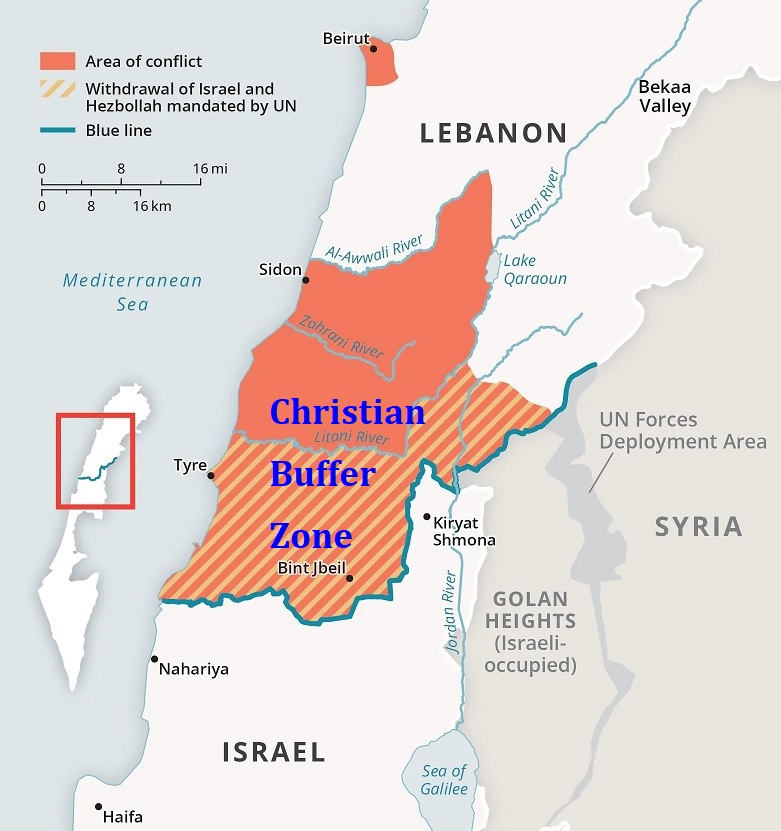
With a Christian Buffer Zone between Israel and
Hezbollah, direct conflict between the two sides would be prevented. Both
Christian Lebanese and Israelis could then live peacefully side by side along
the Israel–southern Lebanon border. This would provide a realistic path to
permanently ending the cycle of military conflicts between Israel and Hezbollah。
While the Lebanese government is responsible for relocating Muslims out of this area, Israel should also help Lebanese Christians move into this Christian Buffer Zone and protect and restore the Christian heritage in this area. This is the key to bringing God’s blessing for lasting peace and prosperity in the region.
For more detailed information, please visit: "The
Peaceful Solution to End the Conflict between Israel and Hezbollah in Southern Lebanon".
This is the New Revelation of God on the peaceful
solution to end the war in Iran and transform Iran into a modern democratic
nation with peace and prosperity for the New Millennium of Peace and Wisdom.
God Bless Iranians!
Download
the PDF Version of this Revelation on the War in Iran